
Take Action:
Spotlighting Impact
Ready to get to work?
There’s no shortage of transformation resources out there developed by institutions, researchers, and organizations leading the way on equitable student success. But with so many available, it can be difficult to know where to begin or which tools are truly built for action.
This page spotlights a small set of high-impact resources that do more than inform. These frameworks and tools are designed to help you roll up your sleeves and take the next step. Each one is practical, proven, and aligned with how transformation actually happens on the ground
Use them to organize your efforts, engage your teams, and move your transformation work forward.

Take Action: Spotlighting Impact
Ready to get to work?
There’s no shortage of transformation resources out there developed by institutions, researchers, and organizations leading the way on equitable student success. But with so many available, it can be difficult to know where to begin or which tools are truly built for action.
This page spotlights a small set of high-impact resources that do more than inform. These frameworks and tools are designed to help you roll up your sleeves and take the next step. Each one is practical, proven, and aligned with how transformation actually happens on the ground
Use them to organize your efforts, engage your teams, and move your transformation work forward.

ISSUE 02 – OCTOBER 2026: Institutional Readiness
The second Field Guide from the team behind The Guide for Postsecondary Changemakers (CM) is here. Like every issue, it distills the CM evidence base into one actionable topic, drawing on case studies, tools, and approaches from transforming institutions rather than untested theory.
This issue focuses on institutional readiness: the degree to which an institution is prepared to begin or advance transformation. Many institutions recognize the need for change but stall before they are ready to act. Readiness is more than willingness. It reflects whether an institution has the shared understanding, alignment, capacity, and resources to undertake meaningful change and sustain it. It is also not a fixed state: institutions can be ready in some areas while still developing in others.
Inside, you’ll find five signals of a transformation-ready institution, three practice lenses for diagnosing where your team stands, implications for every role, and reflection questions to bring to your next team meeting.
ISSUE 01 – JULY 2026: Strategic Data Use
Field Guides are a quarterly practitioner resource from the team behind The Guide for Postsecondary Changemakers (CM). They distill the CM evidence base into one actionable topic per issue. Designed as a 30-minute read, each Field Guide leaves you with emerging insights for practice and new ideas to try at your institution.
Each issue is grounded in real field experience, not assumptions or untested theory. Rather than introducing new models, The Field Guide curates validated case studies, tools, and approaches from transforming institutions — from community colleges to minority-serving institutions — and organizes them around what practitioners actually need: ways to see patterns clearly, make meaning together, and act on what they learn.
This first issue focuses on a core institutional capacity within the Institutional Transformation Framework: strategic data use.
Strategic data use is how institutions turn information into action. It extends beyond reporting dashboards and averages by embedding disaggregated evidence, shared metrics, and learning routines into everyday decision-making. When this capacity is strong, data are accessible, routinely examined, and used to prioritize action, monitor progress, and inform continuous improvement, not simply document outcomes.
Leading examples of action-oriented resources for institutions transforming for student success.
I want… a framework that centers the student experience and structures change efforts using a macro-level approach.
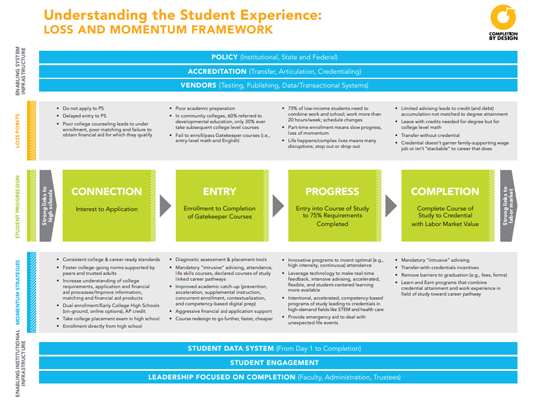
The Loss/Momentum Framework
The Loss/Momentum Framework (LMF) is one of several frameworks that lay out an approach to institutional transformation at a high level. Specifically, the LMF prioritizes better understanding the student experience and using that understanding to identify specific areas within the institution for reform and redesign.
View More
Like most frameworks, the LMF connects to many principles of how institutions transform and is relevant across many stages of the transformation journey.
- It is particularly useful in the early stages of the transformation journey, for institutions seeking to Lay the Groundwork, Start the Process, or Sharpen the Focus.
- The LMF’s Momentum Strategies highlight many Evidence-Based Practices (including advising and developmental education reform) and organizes them according to when they appear along the student experience.
- It bolsters the Student-Centered Mission capacity by clearly prioritizing the experiences of students at the center of transformation efforts.
- It strengthens the Catalytic Leadership capacity by offering senior leaders an approach to organizing transformation efforts at the highest level and providing mid-level leaders with a helpful structure for organizing and working within cross-functional teams.
Learn more about the value of centering the student experience, as well as step-by-step guidance for using the LMF to structure change efforts in this LMF inquiry guide.
View the original LMF one-pager for a concise, visual breakdown of the framework.
View an updated LMF one-pager created by Achieving the Dream that expands the framework to include a fifth stage, Transition, that covers the student experience of transitioning into the workforce or to another institution.
I want… tools designed for mid‑level leaders driving change that guide planning, execution, and reflection across transformation projects.
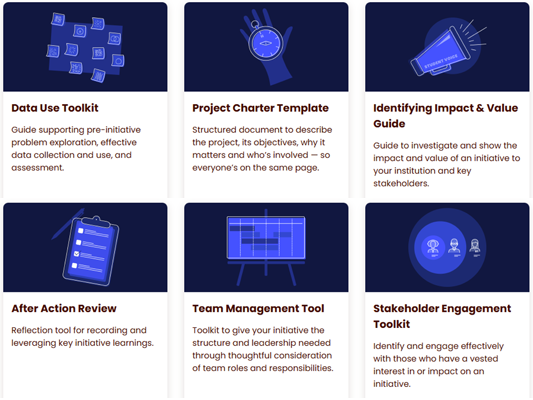
The Mid-Level Leader Toolkit
The Mid-Level Leader (MLL) Toolkit is a suite of six tools collaboratively designed by a group comprised of mid-level leaders at institutions and higher education researchers. It’s grounded in the notion that long-term transformation efforts are made real by implementing specific projects or initiatives, and the success of those projects is heavily dependent upon the ability of mid-level leaders to provide support in a handful of critical ways that shift over the life of the project.
View More
The tools in the MLL Toolkit represent the most critical functions that MLLs have carried out in previous institutional transformation initiatives. They are designed to help MLLs perform these roles more efficiently and sustainably, while maintaining high quality. Many of these functions are closely aligned with Continuous Improvement Processes, which provide the structure and process discipline needed to implement with fidelity and embed effective practices over time.
The tools, and examples of their most relevant connections to the principles of how institutions transform, are…
- Data Use Toolkit – Tied to the Strategic Data Use capacity, this tool supports target-setting and performance tracking.
- Project Charter Template – This tool provides critical structure for planning, ideal for teams in the Sharpen the Focus stage.
- Team Management Tool – This tool supports the Catalytic Leadership capacity by helping leaders build and manage strong cross-functional teams.
- Stakeholder Engagement Toolkit – This tool strengthens Catalytic Leadership capacity by providing strategies for inclusive engagement.
- After Action Review – This tool bolsters institutions’ Strategic Data Use capacity by supporting reflection and building lessons into efforts going forward.
- Identifying Impact & Value Guide – This tool engages Catalytic Leadership capacities by supporting leaders in communicating the impact and value of a project after implementation.
Explore the Mid-Level Leader Toolkit in more detail.
I want… a tool that guides data-informed reflection across campus to identify and unify around strengths, opportunities, and shared student success priorities.
The Institutional Transformation Assessment
The Institutional Transformation Assessment (ITA) is a reflection tool that helps colleges and universities take a clear, data-informed look at their student success efforts and the institutional structures that support them. Through perception surveys, analysis, and guided dialogue, the ITA enables institutions to identify strengths, improvement opportunities, and shared priorities for change.
View More
Upon completion, campus leaders receive customized reports that inform a Sensemaking Conversation, a facilitated process that turns data into shared understanding and helps teams prioritize direction and next steps for action. The ITA assesses eleven integrated topic areas, including Pathways, Advising, Leadership and Culture, Digital Learning, and Institutional Policy.
Like most frameworks featured in the Hub, the ITA connects to many principles of how institutions transform and is relevant across multiple stages of the Transformation Journey:
- Lay the Groundwork – Establishes a shared baseline of data and reflection to align leadership and communicate the urgency for change.
- Start the Process – Clarifies institutional priorities, identifies barriers, and engages cross-functional leaders in collaborative Sensemaking.
- Sharpen the Focus – Helps teams pinpoint high-impact priorities and measurable next steps that lead to actionable goals.
- Act with Purpose – Uses the resulting Transformation Roadmap to align reforms across advising, teaching, and student supports.
- Sustain and Evolve – Encourages campuses to revisit results, monitor progress, and embed reflection and continuous improvement processes into institutional culture.
The ITA strengthens Strategic Data Use, Catalytic Leadership, and Leadership & Culture capacities by turning data into insight, insight into coordinated action, and action into shared accountability. In doing so, it cultivates a culture of collaboration, transparency, and continuous learning that sustains long-term transformation.
Developed in 2016 and refined through user feedback, the ITA includes more than one hundred indicators, interactive dashboards, and facilitation guides. Hosted by the Gardner Institute, it is used annually by more than one hundred institutions committed to parity of outcomes in student success and systemic transformation.
Click here to learn more and sign up for the ITA and sense making.
I want… leadership tools for equity-centered change that drive vision, align people and resources, and sustain systemic transformation.
The Change Leadership Toolkit
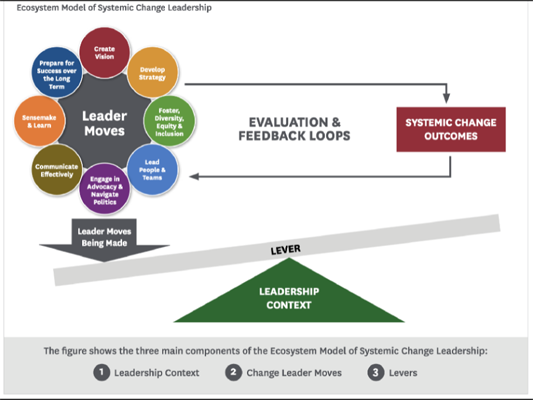
The Change Leadership Toolkit (CLT) is a step-by-step guide to create catalytic leadership for change agents at any level to be able to assess and make decisions throughout the entire change journey. It works in tandem with the stages laying the groundwork through sustain and evolve to help you identify appropriate leaders actions (which we call leader moves).
View More
It helps you and your change team execute on the core institutional capacities by outlining key steps of catalytic leadership, strategic finance, strategic data use, student centered mission, as well as other institutional capacities like communications, partnerships and policy.
Importantly, it helps you assess your unique context and how it might shape what and how you make your leader moves, helps you identify levers which can accelerate change processes, and particular opportunities and challenges you might face.
It is an evidence-based toolkit drawing on decades of research on how change agents/leaders have actually created change in higher education. It includes several worksheets aimed at teams charged with making changes, which are:
- The What, Why and Who of Change – to ensure you are starting with a solid foundation
- A Change Leader Moves Inventory – to assess the status of your current leadership approach
- Evaluating your Change Context – to identify opportunities as well as challenges that lie in your change path
- Identifying Change Levers – to accelerate your change process
- Developing your own Ecosystem Map of Systemic Change – to paint a picture of your unique change landscape
- Creating a comprehensive Change Leadership Plan – to help you and your change team put change leader moves into action to reach your goals
The authors have produced several other resources you might find useful in understanding how the CLT can help you. Explore case studies and other resources to complement utilizing the Change Leadership Toolkit at your institution.
I want… access to student data that supports equitable outcomes, tracks progress, and offers actionable, early momentum metrics.
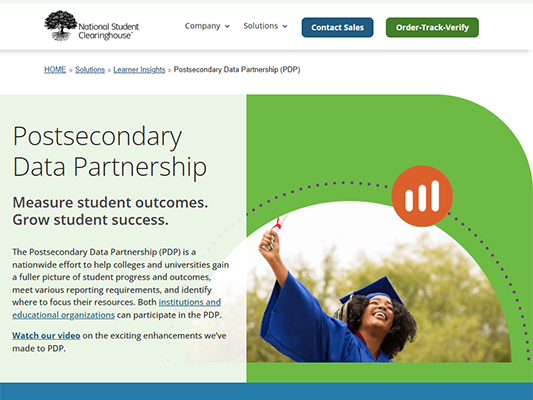
The Postsecondary Data Partnership
The Postsecondary Data Partnership (PDP) is an ongoing, nationwide student data platform focused on student outcomes. Unlike limited datasets from sources like IPEDS or one-off grant reports, the PDP offers institutions a more holistic and actionable way to measure, monitor, and improve student success. For institutions with lean or growing institutional research and data teams, participating in the PDP can transform the way you measure and report students’ progress toward a credential – it tracks all new students (not just full-time, first-time fall entrants), integrates the latest learning about early momentum indicators of student success, and provides benchmarking tools to compare performance across peer institutions.
View More
The PDP is well-positioned to support institutions’ Strategic Data Use capacity. What makes it such a standout resource is how broadly it supports that core capacity across all five stages of the transformation journey:
- Lay the Groundwork – The PDP can provide a foundation of student data critical for communicating the urgent need for institutional transformation and supporting on-the-ground transformation efforts that follow.
- Start the Process – The early momentum metrics available through the PDP can help establish a shared baseline that centers the student experience and is representative of the entire institution.
- Sharpen the Focus – Teams of experts can review disaggregated student data to explore opportunities for dramatically impacting the student experience and use those data to set detailed targets for transformation initiatives.
- Act with Purpose – The metrics defined by the PDP simplifies the process of developing implementation plans by providing shared definitions and supporting teams in identifying meso- and micro-level metrics to track in support of macro-level targets.
- Sustain and Evolve – The PDP’s dashboards provide clear reference points for monitoring progress against targets and iterating practices to increase outcomes.
Explore the Postsecondary Data Partnership (PDP) in more detail.
Artificial intelligence is creating real opportunities for institutions to strengthen how they identify students who need support, how leaders allocate resources, and how staff spend their time. But a national study found that most institutions are still in the early stages of figuring out how to use AI well, and those moving forward fastest possess resources, strategy, and readiness, not just enthusiasm. For institutions committed to equitable student success, that makes intentional adoption essential. This spotlight offers research-grounded resources to help leaders assess where their institution stands and take practical next steps from there.
I want… to understand where my institution stands on AI adoption and get practical next steps for where we are right now.

AI for Institutional Transformation
AI for Institutional Transformation is a research-backed resource suite developed by T3 Advisory that helps higher education leaders at every level assess, plan, and act on AI adoption in ways that advance equitable student success.
T3 Advisory’s approach is built on fieldwork, not assumptions. In collaboration with Complete College America and Learn Consulting, T3 conducted in-depth interviews with institutional leaders across community colleges, regional universities, and R1s. The findings are candid about both what is working and what is not, and the tools that accompany them are designed to meet institutions where they actually are.
View More
Their research gives leaders concrete starting points, organized around the questions institutions are already asking:
- Where can AI create the most impact for students? AI has clear potential to improve advising, financial aid outreach, guided pathways, and course recommendations. But the study found that most AI activity right now is concentrated in teaching and learning, where faculty have more autonomy and fewer data-privacy constraints. T3’s framework maps AI applications directly to the student experience, helping teams see where to focus first and where untapped opportunities exist.
- How do we move forward without leaving people behind? Equity in AI adoption is not just about students; it also means building capacity across all the roles that serve them, such as student services staff, operations teams, or technical infrastructure personnel. T3’s resources guide teams to assess who has access, who has training, and where institutional support structures need to catch up.
- What does our institution actually need to get started, or to move to the next level? Resource levels significantly shape adoption outcomes. But resources are not the whole story. T3’s Institutional AI Adoption Rubric helps teams assess their current state across five dimensions (Adoption Coordination, Leadership Support, Policy Development, Resource Commitment, and Technology Deployment) and identify practical steps forward from wherever they are, not just from where they wish they were.
The findings connect to several core institutional capacities:
- Leadership & Culture: This suite helps leaders build shared AI literacy and model responsible adoption across senior and mid-level leadership.
- Policy: Find help navigating governance, ethics, and compliance considerations based on where you currently stand.
- Information Technology: Assess technology deployment and help govern AI tools within existing infrastructure
- Strategic Data: Evaluate and act on AI-generated insights with the same rigor applied to any student success metric
Whether your team is exploring AI for the first time or ready to move from early experiments to a coordinated strategy, T3 Advisory’s resources are designed to meet your institution where it is and help it move forward from there.

See all Tools and Frameworks
Discover how institutions like yours have navigated their transformation journeys. Browse real-world case studies and gain insights you can apply today.