
Principles of Redesign
Promising Approaches to Transforming Student Outcomes
Publication Date: 2013
Format: Guide (PDF)
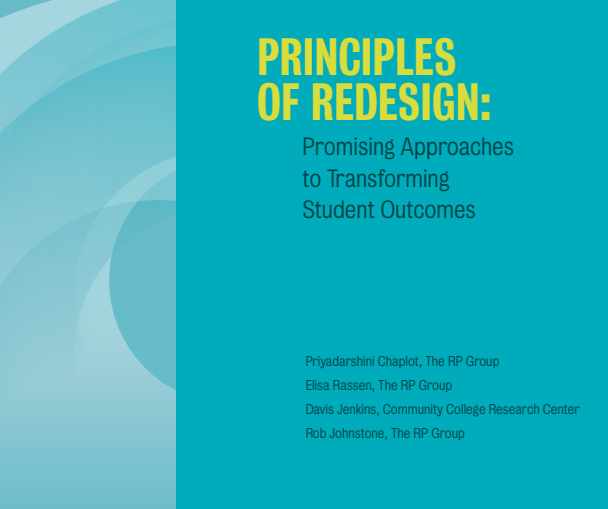
This publication, written in 2013 through the Completion by Design grant project, presents eight core ideas to help colleges address the fundamental challenges to student success. These principles of redesign offer guidance in a comprehensive rethinking of institutions’ most fundamental challenges. Rather than looking to add on interventions that would nibble at the edges of deep-seated issues, this guide provides an opportunity for practitioners at all levels to consider fundamental change in their classrooms, programs of study, departments, divisions, and institutions. None of these principles offer quick fixes to long-standing problems. Instead, they offer an opportunity for community college leaders and practitioners to see their work in a new light, opening up doors to a new level of student success.
Connections to the Transformation Journey
and How Institutions Transform
Stages of Transformation
- Start the Process: This guide is valuable for institutions in the Start the Process stage of a transformation journey, looking to build urgency and momentum for undertaking transformation efforts. By introducing “principles” showcasing new ways to consider the roles, goals, and practices within an institution, this resource can jumpstart the development and acceptance of a vision of a transformed institution, centered around students and their experiences. It provides high-level descriptions of each of its eight principles, accompanied by examples of them in action at institutions across the country, tackles common arguments pushing back against the principle, and ends with discussion questions that move teams toward planning and action.
Learn more about the Transformation Journey and How Institutions Transform.
Evidence-Based Practices
- Other Holistic Supports: While not formally categorized as an Evidence-Based Practice, this report introduces foundational concepts that underpin the Pathways Model—an integrated, institution-wide approach to student success grounded in intentionally designed, coherent, and structured educational experiences. Emerging in the mid-2000s, the Pathways Model represents one of the earliest efforts to move beyond isolated reforms toward comprehensive institutional transformation. In many ways, the Pathways Model, and this report, laid the groundwork for the broader transformation approach reflected across the Postsecondary Changemakers Hub.
Learn more about the Transformation Journey and How Institutions Transform.
Core Institutional Capacities
- Catalytic Leadership: This guide can support a critical role for leaders of institutional transformation: sharing a vision of a transformed institution. It demonstrates a framework for comprehensively rethinking the role of postsecondary institutions in the form of eight principles of redesign – concise, evidence-based stances of what a redesigned institution must do to redefine the educational experiences of its students for the better. These principles offer a powerful starting point for leaders to consider when conceptualizing and discussing what kind of framework their institutions could use to shape their own transformation journeys.
Learn more about the Transformation Journey and How Institutions Transform.
Continuous Improvement
This resource is most relevant to the following cross-functional roles:
- Senior Leaders: This guide supports leaders in building a shared vision for a transformed institution by introducing a framework of eight principles of redesign, useful for developing an approach to transformation that fits the students and context of their own institution. Leadership teams in the process of considering different approaches would benefit from the overarching questions outlined in the Proces of Change section (see page 10).
- Mid-Level Leaders: As the roles tapped to facilitate the actual work of transformation, mid-level leaders would benefit from the framing of potential approaches to transformation provided by this guide’s principles of redesign, as well as the process-informing questions outlined in the Process of Change section (see page 10). The Additional Resources section at the end also includes research, recommendations, guides, and toolkits for supporting planning and implementation efforts.
This resource connects to the following phase(s) of the PRPAM framework:
- Prepare: This guide is ideal for institutions at the start of a continuous improvement process, offering foundational framing for what transformation might look like, its goals and ambitions, and the types of questions to consider to begin taking steps toward redesigning fundamental aspects of the institution in support of a new vision for the student experience.
Learn more about the Transformation Journey and How Institutions Transform.
Other Considerations
- Although originally developed through the Completion by Design initiative with two-year colleges, this resource is relevant for institutions of all types.
- Published over a decade ago, the resource remains foundational but reflects the context of its time. Since its release, the field has advanced in several areas, including:
- More explicit integration of racial and socioeconomic equity in the principles and goals for the student experience;
- Greater emphasis on direct student engagement in identifying challenges, shaping solutions, and assessing their efficacy.
Learn more about the Transformation Journey and How Institutions Transform.
Stages of Transformation
- Start the Process: This guide is valuable for institutions in the Start the Process stage of a transformation journey, looking to build urgency and momentum for undertaking transformation efforts. By introducing “principles” showcasing new ways to consider the roles, goals, and practices within an institution, this resource can jumpstart the development and acceptance of a vision of a transformed institution, centered around students and their experiences. It provides high-level descriptions of each of its eight principles, accompanied by examples of them in action at institutions across the country, tackles common arguments pushing back against the principle, and ends with discussion questions that move teams toward planning and action.
Learn more about the Transformation Journey and How Institutions Transform.
Evidence-Based Practices
- Other Holistic Supports: While not formally categorized as an Evidence-Based Practice, this report introduces foundational concepts that underpin the Pathways Model—an integrated, institution-wide approach to student success grounded in intentionally designed, coherent, and structured educational experiences. Emerging in the mid-2000s, the Pathways Model represents one of the earliest efforts to move beyond isolated reforms toward comprehensive institutional transformation. In many ways, the Pathways Model, and this report, laid the groundwork for the broader transformation approach reflected across the Postsecondary Changemakers Hub.
Learn more about the Transformation Journey and How Institutions Transform.
Core Institutional Capacities
- Catalytic Leadership: This guide can support a critical role for leaders of institutional transformation: sharing a vision of a transformed institution. It demonstrates a framework for comprehensively rethinking the role of postsecondary institutions in the form of eight principles of redesign – concise, evidence-based stances of what a redesigned institution must do to redefine the educational experiences of its students for the better. These principles offer a powerful starting point for leaders to consider when conceptualizing and discussing what kind of framework their institutions could use to shape their own transformation journeys.
Learn more about the Transformation Journey and How Institutions Transform.
Continuous Improvement
This resource is most relevant to the following cross-functional roles:
- Senior Leaders: This guide supports leaders in building a shared vision for a transformed institution by introducing a framework of eight principles of redesign, useful for developing an approach to transformation that fits the students and context of their own institution. Leadership teams in the process of considering different approaches would benefit from the overarching questions outlined in the Proces of Change section (see page 10).
- Mid-Level Leaders: As the roles tapped to facilitate the actual work of transformation, mid-level leaders would benefit from the framing of potential approaches to transformation provided by this guide’s principles of redesign, as well as the process-informing questions outlined in the Process of Change section (see page 10). The Additional Resources section at the end also includes research, recommendations, guides, and toolkits for supporting planning and implementation efforts.
This resource connects to the following phase(s) of the PRPAM framework:
- Prepare: This guide is ideal for institutions at the start of a continuous improvement process, offering foundational framing for what transformation might look like, its goals and ambitions, and the types of questions to consider to begin taking steps toward redesigning fundamental aspects of the institution in support of a new vision for the student experience.
Learn more about the Transformation Journey and How Institutions Transform.
Other
Considerations
- Although originally developed through the Completion by Design initiative with two-year colleges, this resource is relevant for institutions of all types.
- Published over a decade ago, the resource remains foundational but reflects the context of its time. Since its release, the field has advanced in several areas, including:
- More explicit integration of racial and socioeconomic equity in the principles and goals for the student experience;
- Greater emphasis on direct student engagement in identifying challenges, shaping solutions, and assessing their efficacy.
Learn more about the Transformation Journey and How Institutions Transform.
Recommended Citation: Chaplot, P., Rassen, E., Jenkins, D., & Johnstone, R. (2013). Principles of Redesign: Promising Approaches to Transforming Student Outcomes. Community College Research Center (CCRC), Teachers College, Columbia University and The Research and Planning Group for California Community Colleges (The RP Group).